
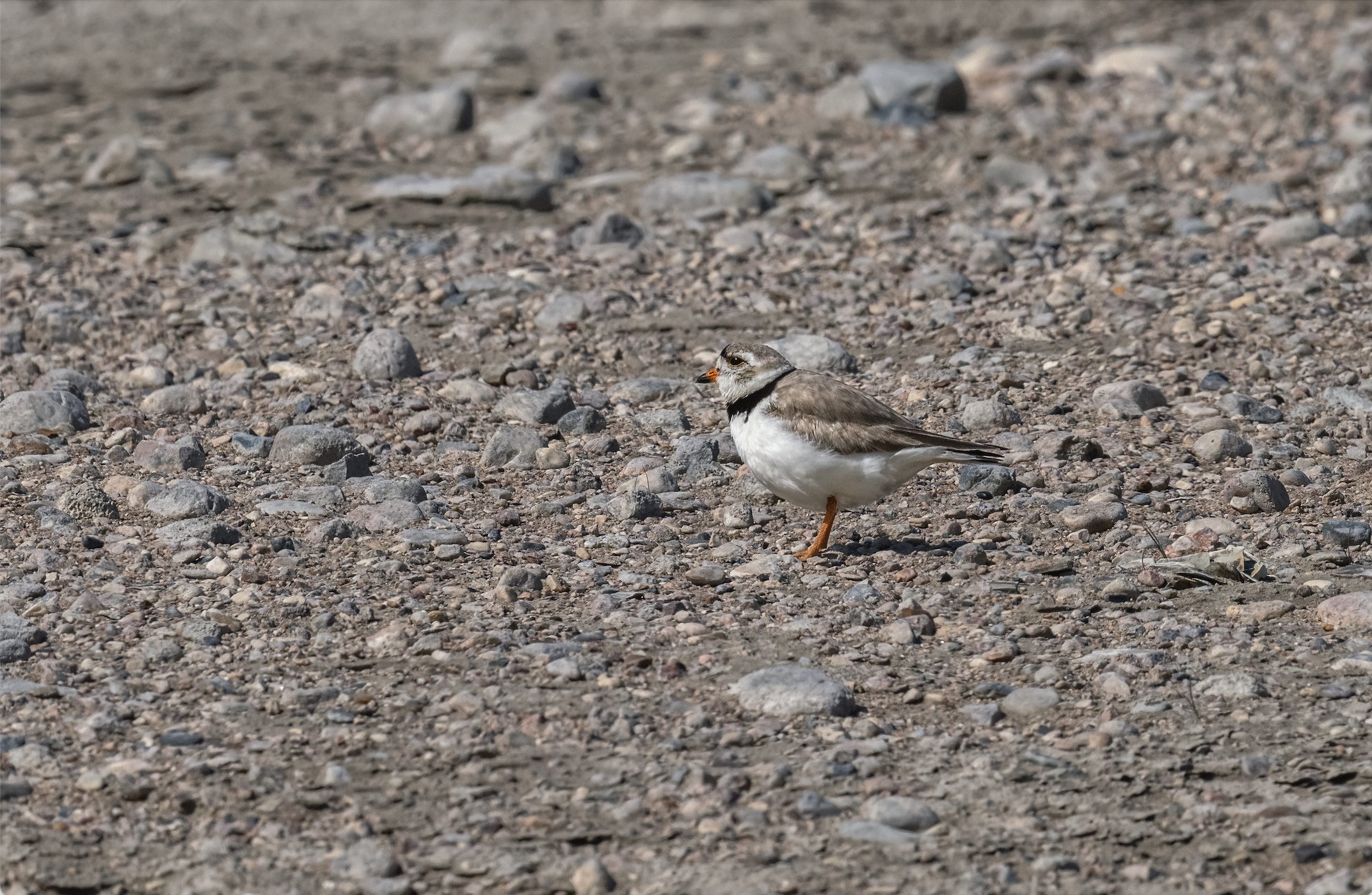
Piping Plover Surveils, Lake Diefenbaker

We often associate shorebirds with the vast coastlines of oceans and seas, but you may be surprised to learn that Piping Plovers and a myriad of other shorebirds are also abundant in the Prairies and Northern Great Plains of the North American interior. In fact, Saskatchewan is home to the largest number of breeding Piping Plovers in Canada, which rely heavily on the rivers and lakes there to sustain their population.
The Piping Plover subspecies circumcinctus has two populations in Canada, both of which are endangered: The Great Lakes population, numbered at around 200 individuals, and the Canadian Prairie/USA Northern Great Plains population, numbered at around 3500 individuals. In this image, we see an adult Piping Plover of the latter population on the shore of Lake Diefenbaker, the largest and longest lake contained entirely within Saskatchewan (it is an outstanding 225 km long, with 800 km of shoreline). Lake Diefenbaker is designated as an IBA (Important Bird and Biodiversity Area) by BirdLife International, who identify significant bird habitat areas in order to guide conservation efforts. Lake Diefenbaker is a critical habitat in the province for a diversity of wildlife, and is one of the largest single nesting sites of Piping Plovers.
Lake Diefenbaker is a man-made lake, created as a part of the South Saskatchewan River Project. In the 1950s, dams were constructed to flood a portion of the South Saskatchewan River in order to make the lake, which provided a new water source in the province for irrigation, hydroelectric power generation, and drinking water.
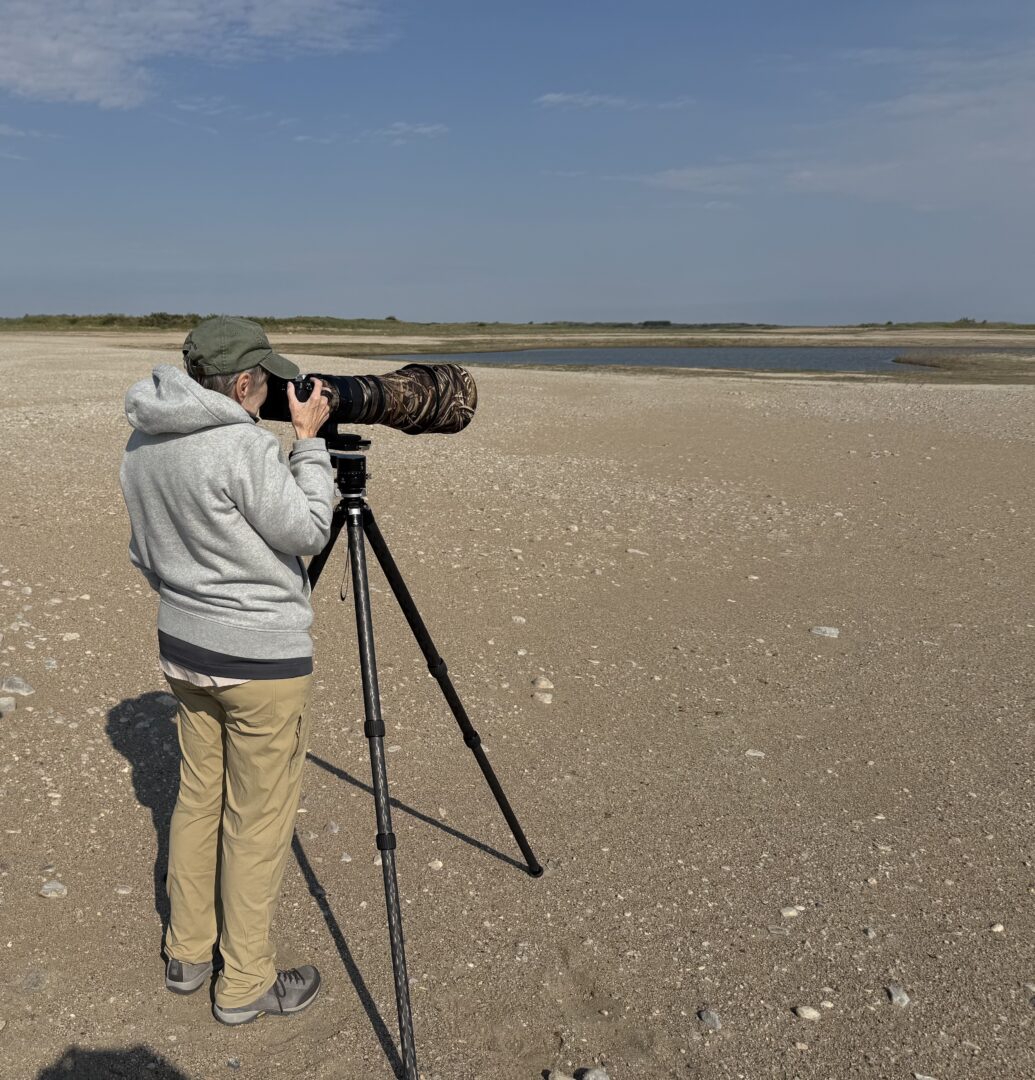

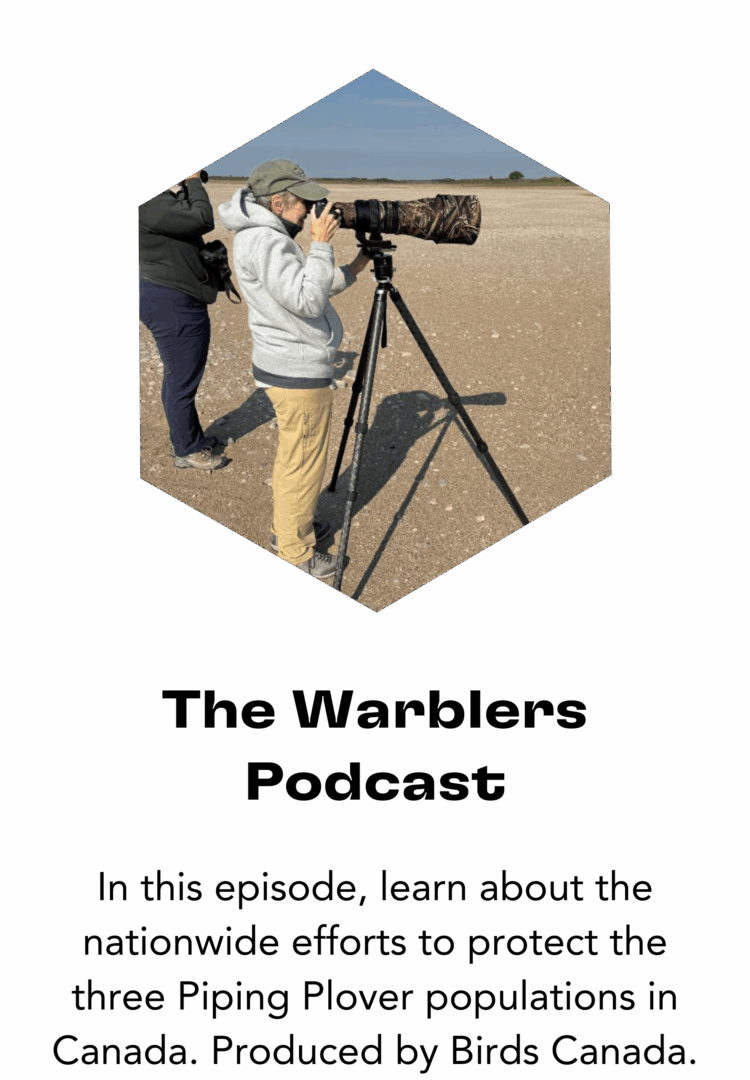
Dr. Bondar photographs Piping Plovers at Lake Diefenbaker, Saskatchewan.
Despite geographical distance and regional differences, the sand and gravel shores of Lake Diefenbaker and other lakes in the region offer similar conditions for breeding and nesting as the coastal habitats used by the Atlantic Piping Plover subspecies melodus. Unfortunately, the challenges they face here are also similar; key threats such as predation, human disturbance, and environmental change on shoreline habitats have all led to low population levels. A prominent concern is increased heavy rains and spring runoff in recent years, which has led to severe water level fluctuations and flooding. Occasional floods or other disturbances are normal and actually help to control vegetation growth and maintain the natural characteristics of the habitat. However, the frequency and intensity of flooding in recent years is significantly higher than normal, harming nests and young fledglings. While large numbers of Piping Plovers breed and nest at Lake Diefenbaker, their success is currently low, leading to declining population levels.
Saskatchewan’s Water Security Agency (WSA) is responsible for Piping Plover conservation management at Lake Diefenbaker, undertaking surveys, monitoring, and working tirelessly to improve nest success. Nests are protected with wire enclosures that make the well-camouflaged Piping Plovers easier to identify and less likely to be disturbed by humans, and during periods of high flooding, the WSA has even moved nests to higher ground by hand to protect the eggs.
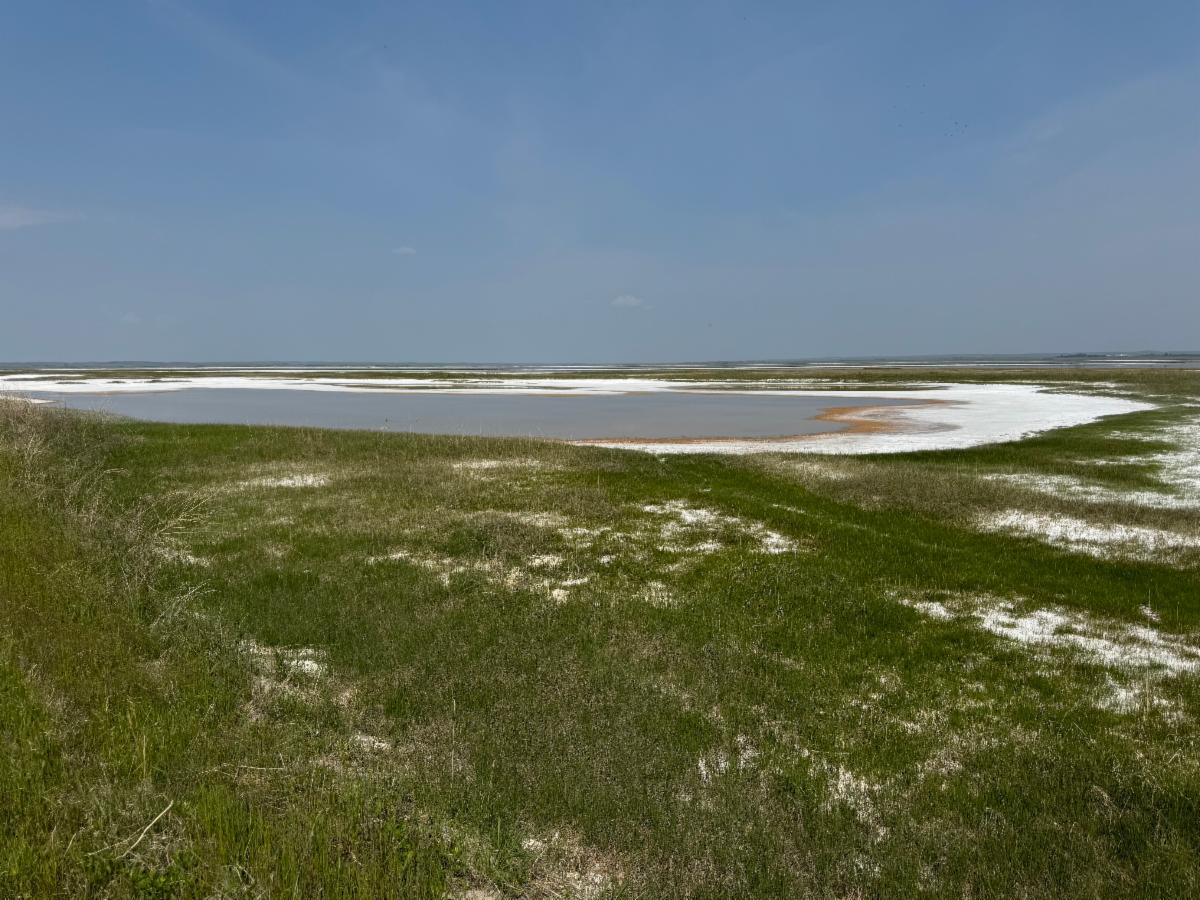
Chaplin Lake, Saskatchewan. The white around the lake edge is salt!
Other important lake and river habitats for the Piping Plover circumcinctus subspecies exist throughout Saskatchewan. Chaplin Lake, also an IBA, is a salt lake (the second largest in Canada) located in southwest Saskatchewan in the Prairie Pothole region. Like Lake Diefenbaker, Lake Chaplin hosts tens of thousands of shorebirds annually, including Sanderlings, Semipalmated Sandpipers, Baird’s Sandpipers, and the endangered Piping Plover. The rich minerals of the lake allow shrimp populations to thrive here, providing ample food for migratory birds. The mining developments around the lake extract sodium sulphate, but also work to manage the lake’s water levels, which fluctuate significantly and can even dry up altogether. Maintaining water levels sustains both the lake and the important food sources it provides for the journeys of migratory birds. Another image in the exhibition, “Piping Plover on Salt Lake Shore”, features a Piping Plover walking on the salty shoreline of this lake.
Explore more below to learn about the different Piping Plover populations found across North America!

Sources
- U.S. Fish & Wildlife Service: https://www.fws.gov/species/piping-plover-charadrius-melodus
- Environment and Climate Change Canada: https://www.canada.ca/en/environment-climate-change/services/species-risk-public-registry/action-plans/piping-plover-saskatchewan-proposed-2009.html
- BirdLife International IBA (Important Bird and Biodiversity Areas) – Lake Diefenbaker: https://www.ibacanada.com/mobile/site.jsp?siteID=SK055
- BirdLife International IBA (Important Bird and Biodiversity Areas) – Lake Chaplin: https://www.ibacanada.com/mobile/site.jsp?siteID=SK033
- Tourism Saskatchewan: https://www.tourismsaskatchewan.com/blog/shorebirds-at-chaplin-lake